Remote Identification (or Rid) is a technology that allows a drone to broadcast its identity and flight status information. Rid typically uses Wi-Fi or Bluetooth for broadcasting, and it is unencrypted. This allows the general public and regulatory agencies to receive and decode the information to know if a drone is nearby. Regulatory agencies can use Rid to find the pilot's location and even query the drone's registration information from the UOM system using its unique serial number.
1. History of Remote ID
DJI drones became popular around 2013, leading to a rise in incidents of drones flying into government buildings and invading public privacy. This sparked discussions about licensing drones.
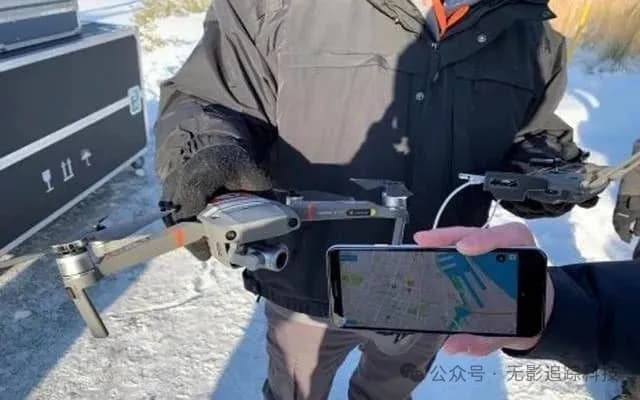
On November 13, 2019, at the International Civil Aviation Organization's (ICAO) third Drone Enable Symposium in Montreal, Canada, DJI publicly demonstrated a remote ID solution that directly connects drones to mobile devices using public Wi-Fi technology, enabling localized remote identification of drones. The solution aimed to provide technical support to European and American aviation regulatory agencies to create a safe airspace. Attendees successfully used smartphones to receive wireless broadcast signals from DJI's Mavic Air and Mavic 2 Enterprise drones.
In August 2020, Intel announced their Open Drone ID solution, which uses Bluetooth broadcasting and is similar to the Wi-Fi solution.
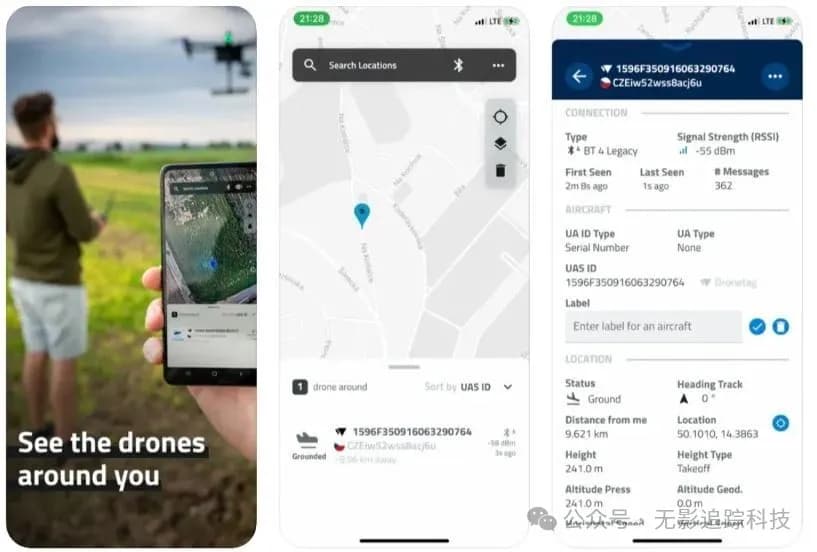
Both DJI's and Intel's solutions were eventually adopted into the standard, offering significant advantages over other proposals. First, they don't require adding extra electronic modules to the drone, as most drones already have Wi-Fi or Bluetooth (for connecting to hotspots to transfer videos and photos to a mobile app). Second, smartphones also have Wi-Fi and Bluetooth, so the public only needs to install an app to receive Rid broadcasts without purchasing special equipment. Third, some other solutions require cellular networks, which would incur costs.

2. Standards and Regulations
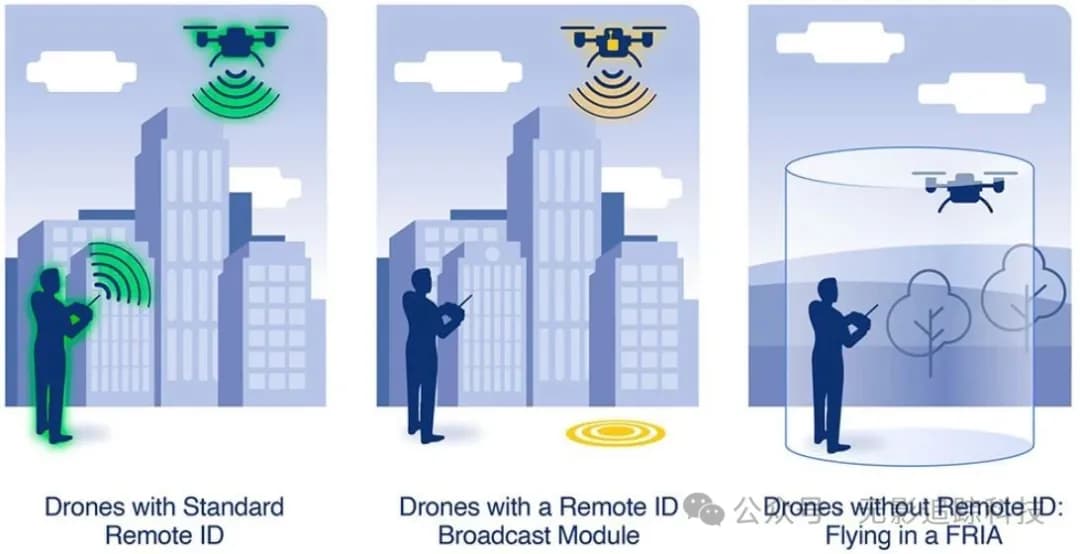
The United States' Remote ID standard is primarily issued by the Federal Aviation Administration (FAA), with its core regulation, 14 CFR Part 89, officially announced in December 2020. In June 2022, ASTM published F3586-22 as an implementation standard for FAA Remote ID compliance, further detailing the technical compliance methods.
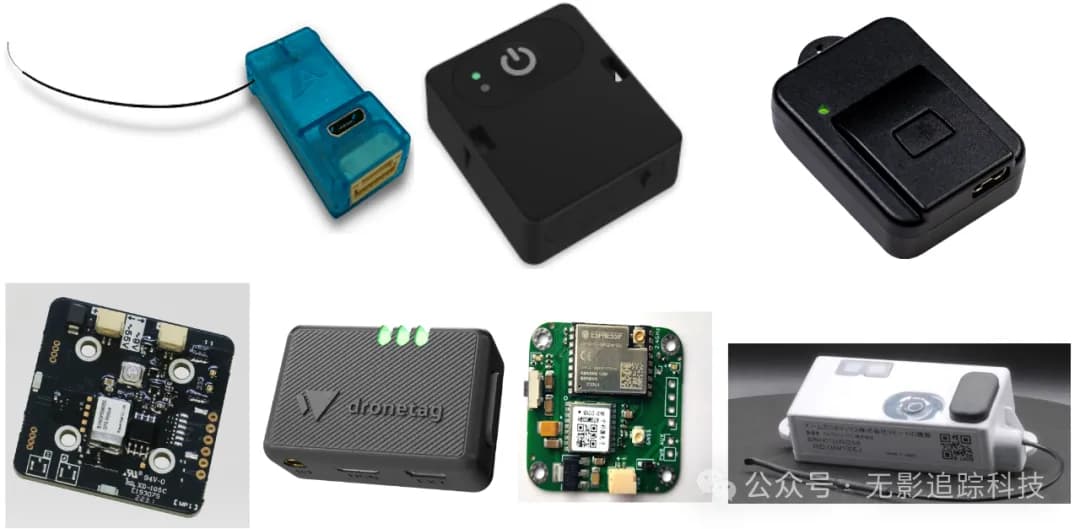
You must either purchase a drone with built-in Rid functionality or retrofit your drone with a Rid module. Drones without Rid broadcasting capabilities can only be flown within visual line of sight and are not allowed to fly over people or in other no-fly zones.
Europe's Remote ID standard is mainly defined by the "EU Drone Regulation" (EU 2019/947), which came into effect on December 30, 2020. The EU's Remote ID rules were developed in parallel with the FAA's Remote ID standard. The European Rid technical standards are largely similar to those in the US, with differences in frequency bands and a few fields.

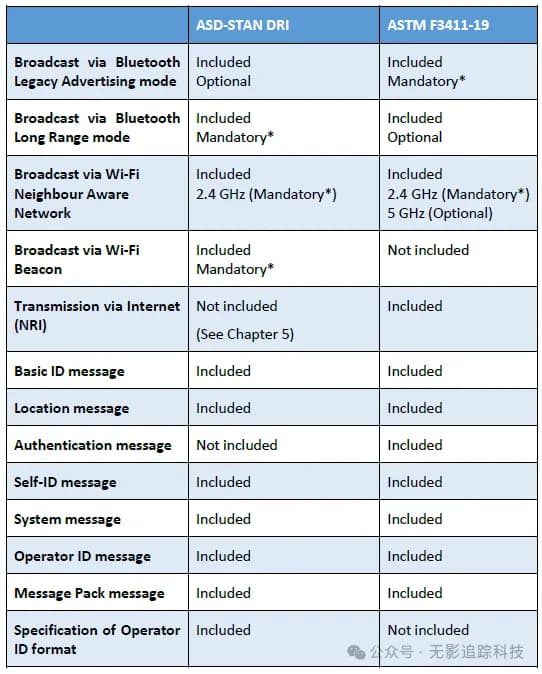
In 2023, China released the "Interim Regulations on the Flight Management of Unmanned Aerial Vehicles," the "Safety Management Rules for the Operation of Civil Unmanned Aerial Vehicles," GB 42590-2023 "Safety Requirements for Civil Unmanned Aircraft Systems," and the "Minimum Performance Requirements for Operational Identification of Civil Micro, Light, and Small Unmanned Aerial Vehicles (Trial)." These all mandate the use of Bluetooth or Wi-Fi for remote identification.
3. Technical Principles
1. Field Definitions
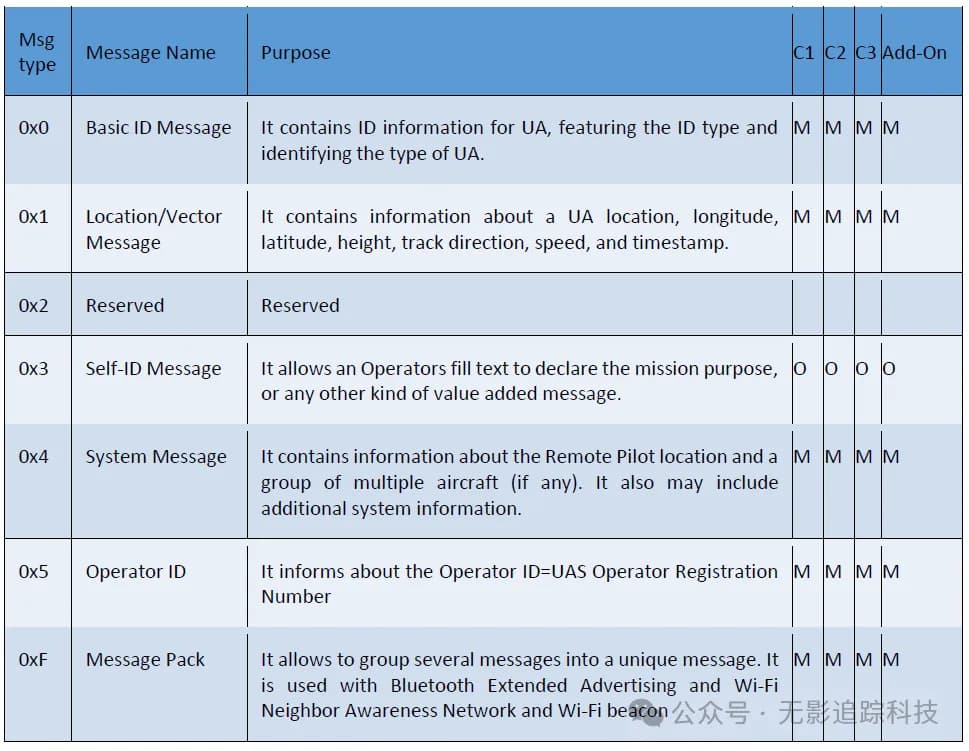
2. Classification
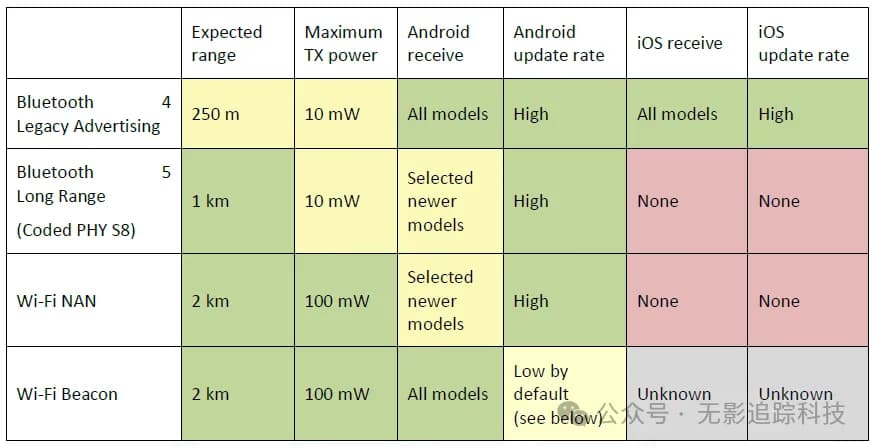
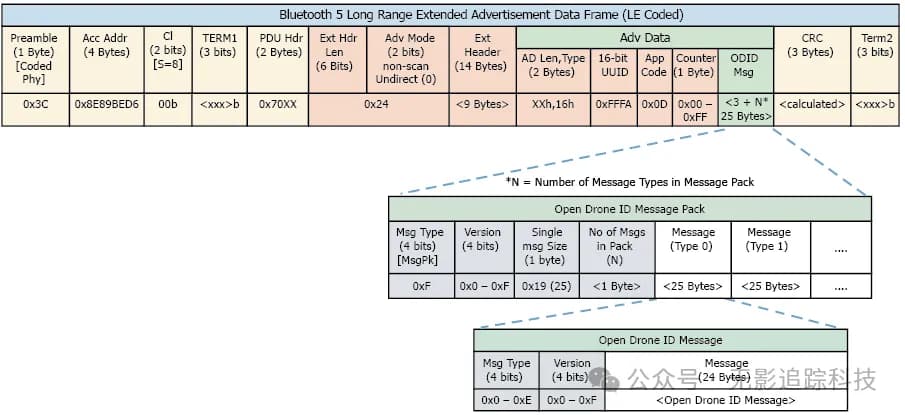
Bluetooth Rid broadcasting is divided into Bluetooth 4 and Bluetooth 5 (Long Range). Wi-Fi broadcasting is divided into Wi-Fi NAN and Wi-Fi Beacon. The coverage, transmission power, and mobile phone reception compatibility are shown in the table below.
3. Bluetooth Rid Broadcasting
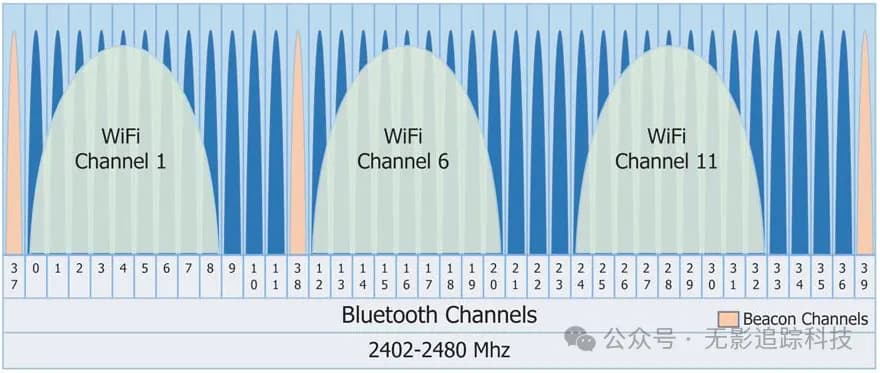
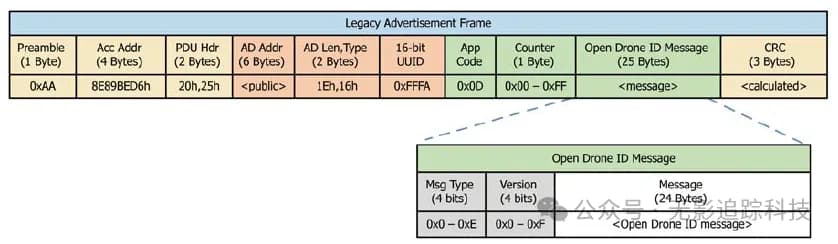
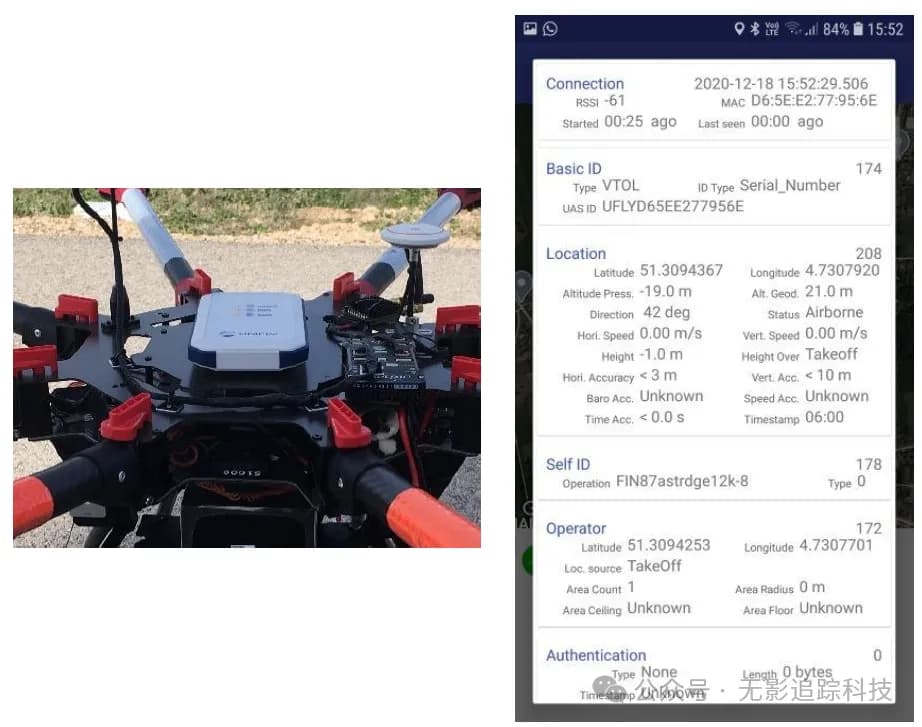
This mainly involves inserting broadcast fields into the reserved fields of the beacon frame. Bluetooth only transmits in the 2.4G band and broadcasts on channels 37, 38, and 39.
4. Wi-Fi NAN
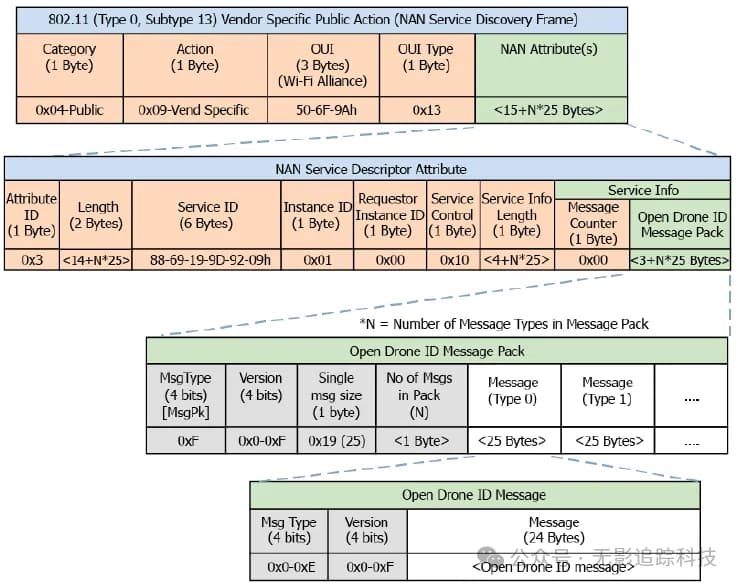
Wi-Fi NAN (Wi-Fi Neighbor Awareness Networking), also known as Wi-Fi Aware, is a protocol innovation for Wi-Fi that emerged in 2015. Its main function is to allow Wi-Fi devices to send information to nearby Wi-Fi devices without establishing a connection. Applications include smart home connections or, for example, a bakery's Wi-Fi detecting a new Wi-Fi device and pushing an ad to your phone as you walk by.
DJI drones typically use Wi-Fi NAN to broadcast Rid. If a phone's Wi-Fi chip is older, it may not support receiving Wi-Fi NAN information.
- 2.4G only uses channel 6 (2.437 GHz);
- If the device only supports the 5G low band (5.150 – 5.250 GHz), it uses channel 44 (5.220 GHz);
- If the device only supports the 5G high band (5.725 – 5.825 GHz), it uses channel 149 (5.745 GHz);
- If the device supports both 5G high and low bands, it uses channel 149 (5.745 GHz);
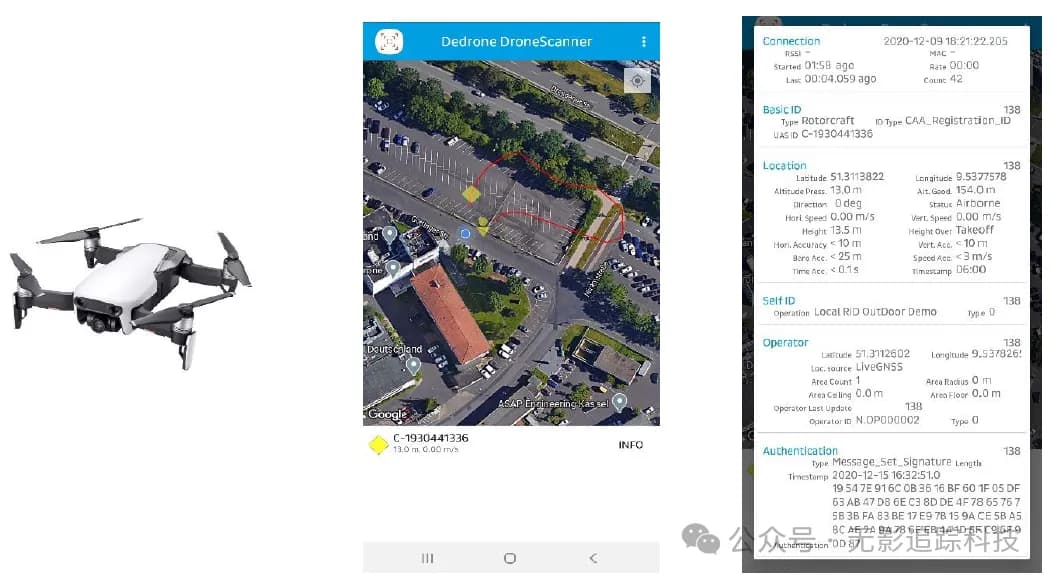
5. Wi-Fi Beacon
A Wi-Fi beacon is a signal broadcast by a hotspot to tell nearby Wi-Fi devices to connect to it. Every time you open your phone to connect to Wi-Fi, the list of available hotspots you see is from receiving these beacon signals. Wi-Fi beacon frames are usually sent at the lowest supported rate (because a lower rate requires a lower signal-to-noise ratio) to ensure that all potential receiving devices can receive this important information. The modulation method is typically BPSK.
Parrot drones generally use beacons to broadcast Rid on channel 2437M.
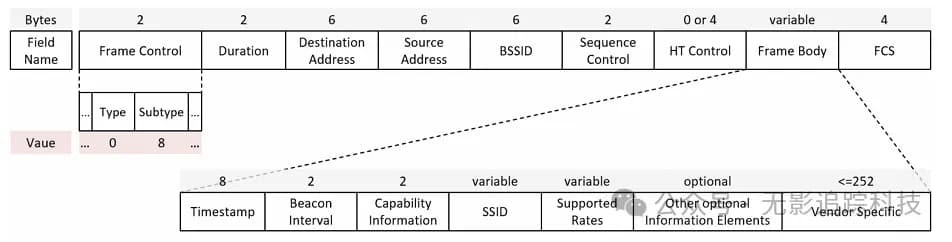
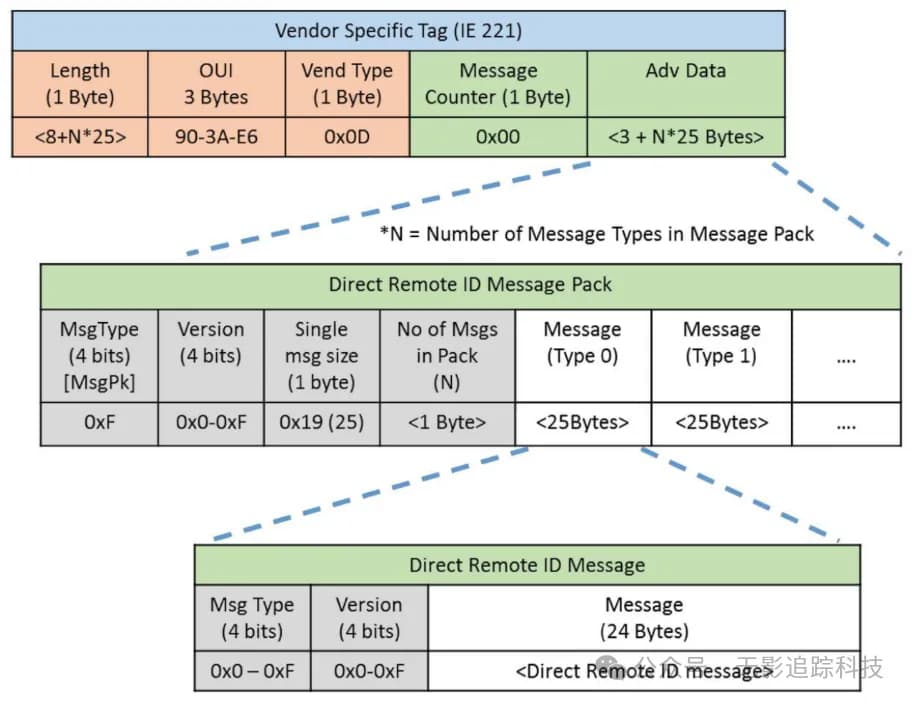
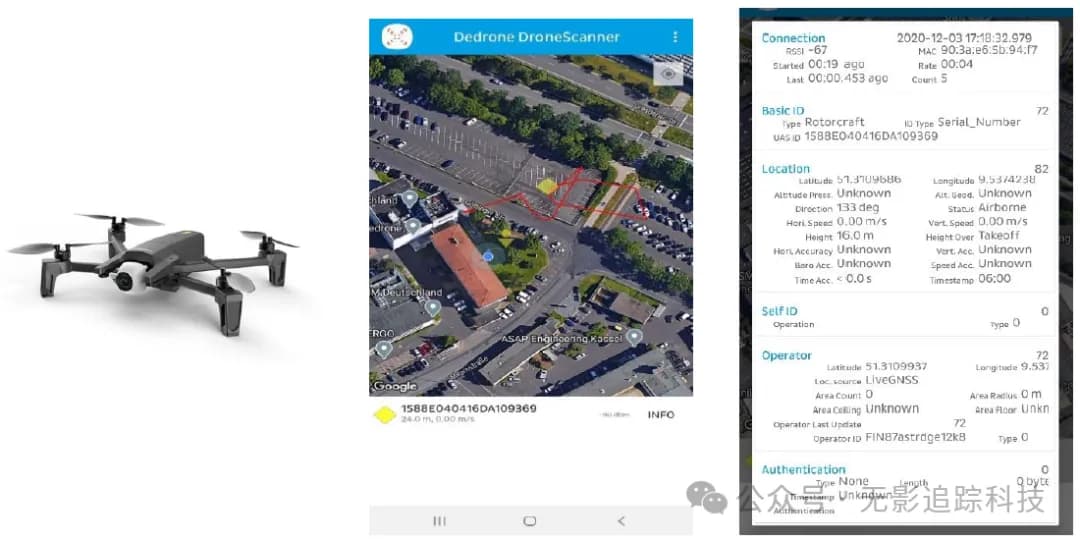
Due to length constraints, the next article will cover using a detection module to detect Rid and the factors that affect Rid detection distance.